

The CMC Regulatory Shift: AI-Powered vs. Manual Workflows in Modern Regulatory Operations
How AI-enabled regulatory operations platforms are transforming CMC submissions, eCTD workflows, compliance management, and cross-functional coordination for modern pharma organizations
Introduction
A New Era for Regulatory Operations
The pharmaceutical and biotechnology industry is entering a new era of regulatory operations. As biologics, cell and gene therapies, RNA therapeutics, and advanced manufacturing programs increase in complexity, traditional manual regulatory workflows are becoming increasingly difficult to scale.
For regulatory affairs CMC teams, the challenge is no longer only scientific accuracy or regulatory strategy. The larger operational challenge is coordinating enormous volumes of structured and unstructured data across manufacturing, quality, safety, clinical, and regulatory systems while maintaining submission readiness.
Many organizations continue to rely heavily on spreadsheets, email chains, shared drives, disconnected repositories, and manual document assembly processes to manage critical regulatory activities. While these methods may have worked for smaller pipelines, they create operational friction, duplicated effort, inconsistent data handling, and extended review cycles at enterprise scale.
This is where AI-enabled regulatory operations platforms are beginning to change how regulatory teams work.
The Problem
Why Traditional Regulatory Workflows Create Operational Bottlenecks
Most enterprise regulatory systems were originally designed for document storage, workflow routing, and submission management rather than intelligent orchestration across the broader regulatory ecosystem.
As submission complexity grows, regulatory teams frequently spend substantial time on:
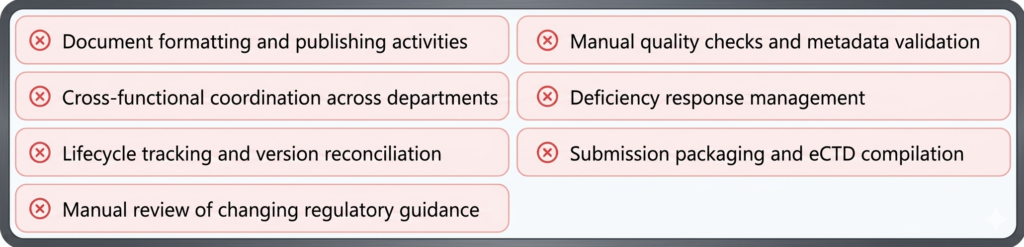

These operational inefficiencies become even more pronounced in complex modalities such as biologics, advanced therapies, and global multi-market submissions.
Comparison
AI vs. Manual Regulatory Operations
The industry conversation is no longer about whether artificial intelligence can support regulatory operations. The focus is shifting toward how organizations can reduce administrative overhead while enabling regulatory professionals to focus on higher-value scientific and strategic work.
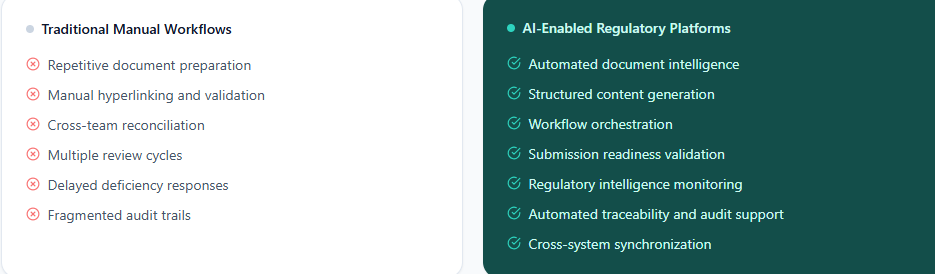
| Key insight: The goal is not to replace regulatory expertise. The objective is to reduce operational burden so experienced regulatory professionals can focus on scientific interpretation, risk assessment, compliance strategy, and health authority engagement. |
Key Capabilities
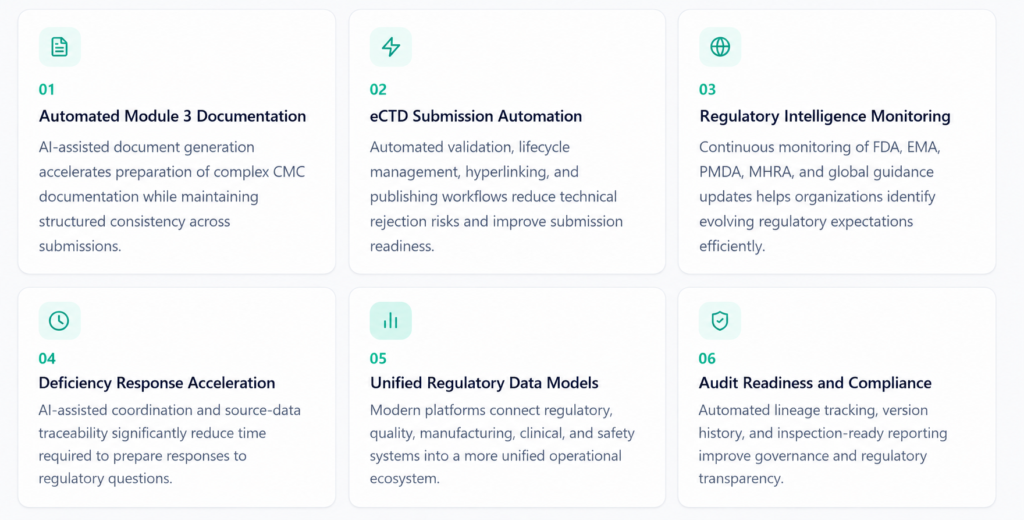
Key AI Capabilities Transforming Regulatory Affairs CMC
Complex Modalities
Why AI Matters for Biologics and Advanced Therapies
Organizations developing biologics, cell and gene therapies, RNA therapeutics, and specialty pharmaceutical products face regulatory complexity that extends far beyond traditional small-molecule submissions.
These programs often involve:
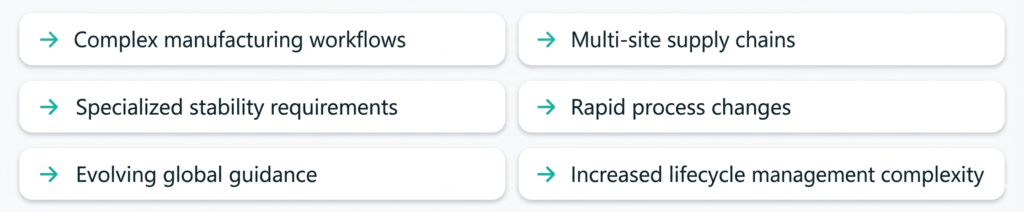
In these environments, operational coordination becomes a major challenge. AI-enabled regulatory operations platforms help organizations manage growing submission complexity without scaling operational inefficiencies at the same rate.
Platform
The Role of Mushroom Solutions
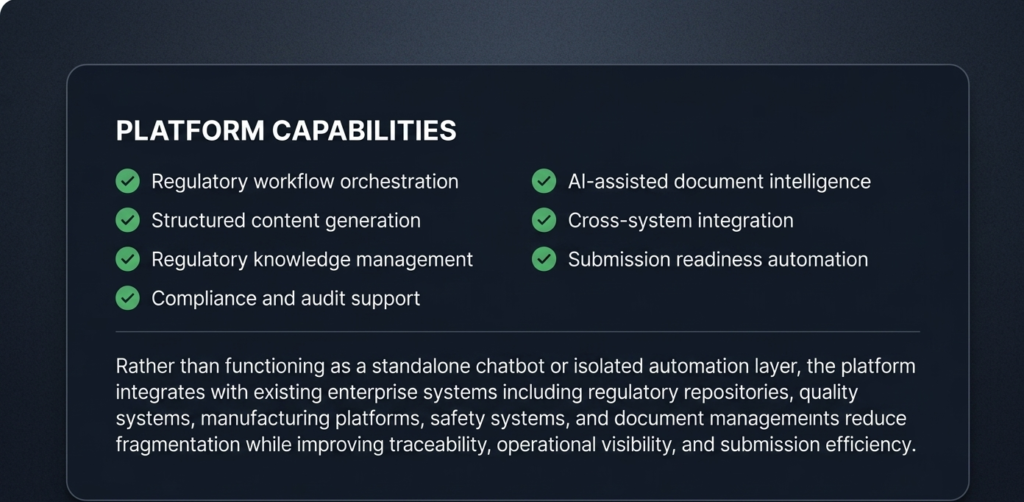
Mushroom Solutions provides an AI-enabled regulatory orchestration platform designed to support modern regulatory operations across IND, NDA, BLA, MAA, and post-approval lifecycle management.
Looking Ahead
The Future of Regulatory Operations
Regulatory affairs has always depended on scientific precision, compliance expertise, and institutional knowledge. What is changing is the operational model surrounding that expertise.
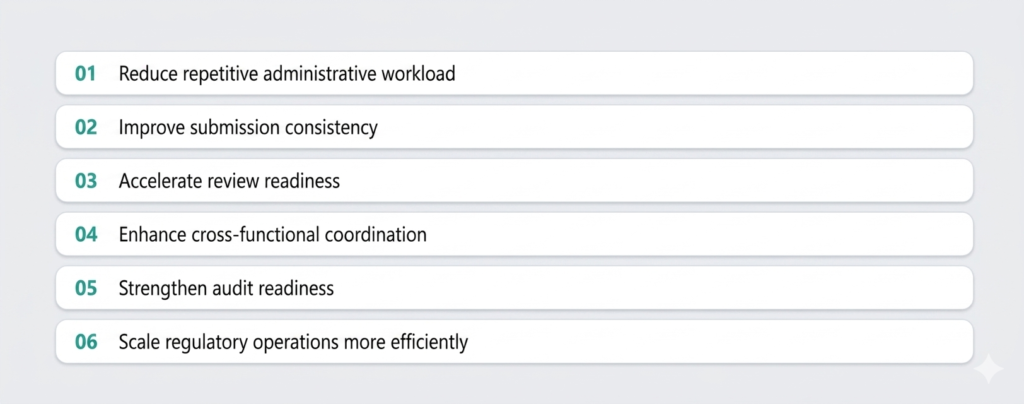
AI-enabled regulatory operations platforms are helping organizations:
“The real opportunity is enabling regulatory teams to operate with greater speed, traceability, scalability, and strategic focus in an increasingly complex global regulatory environment.”
Organizations that modernize regulatory operations today will be better positioned to manage the growing complexity of future submissions, evolving global compliance requirements, and accelerated product development timelines.
Common Questions
Frequently Asked Questions
Get answers to common questions about AI-enabled regulatory operations platforms, implementation, and best practices.
How does AI-enabled regulatory automation differ from traditional document management systems?
Traditional systems focus on storage and routing of completed documents. AI-enabled platforms actively orchestrate workflows, automatically generate structured content, validate submissions before they are submitted, monitor regulatory guidance changes in real-time, and coordinate across multiple departments. This transforms regulatory operations from a passive, document-centric model to an active, intelligence-driven orchestration model.
Can AI regulatory platforms work with our existing systems?
Yes. Modern AI regulatory platforms are designed to integrate with existing enterprise infrastructure including regulatory repositories, quality management systems, manufacturing execution systems, electronic data capture systems, and document management platforms. Integration approaches include APIs, data feeds, and connectors that allow seamless information flow without requiring system replacement.
How does AI improve deficiency response timelines?
AI platforms accelerate deficiency responses by automatically tracing source data across manufacturing, quality, and clinical systems; suggesting relevant documentation based on the regulatory question; identifying gaps in supporting data; and coordinating cross-functional responses. This can reduce deficiency response preparation time from weeks to days.
Is regulatory expertise still important with AI-enabled platforms?
Absolutely. AI platforms are designed to support regulatory professionals, not replace them. Experienced regulatory affairs specialists remain essential for scientific interpretation, risk assessment, compliance strategy, and health authority engagement. AI reduces administrative burden so regulatory professionals can focus on higher-value strategic and scientific activities.
How do AI platforms ensure compliance and audit readiness?
AI-enabled platforms maintain comprehensive audit trails including who accessed data, when changes were made, what was changed, and why. They automatically track lineage from source systems to final submissions, maintain version histories, generate inspection-ready reports, and support regulatory compliance frameworks like 21 CFR Part 11 and GDPR.
What types of submissions can AI platforms support?
AI platforms support IND (Investigational New Drug) applications, NDA (New Drug Applications), BLA (Biologics License Applications), MAA (Marketing Authorization Applications), CMC modules, post-approval supplements, annual reports, and lifecycle management activities. They are particularly valuable for complex modalities including biologics, cell and gene therapies, and advanced manufacturing programs.
How long does implementation typically take?
Implementation timelines vary based on organization size, system complexity, and scope. Organizations typically begin with pilot programs in 3-6 months, then expand across broader regulatory operations. Early wins often include eCTD automation, deficiency response coordination, and regulatory intelligence monitoring.
Can the platform handle multiple regulatory submissions simultaneously?
Yes. AI platforms are designed for enterprise scale and can manage multiple concurrent submissions across different regulatory jurisdictions. They help maintain consistency across submissions while adapting to region-specific regulatory requirements.
How are regulatory guidance updates monitored and tracked?
AI platforms continuously monitor guidance databases from FDA, EMA, PMDA, MHRA, and other regulatory authorities. They alert relevant teams when new guidance is published, automatically assess impact on current and planned submissions, and suggest required updates to submission strategies.
What security measures protect sensitive regulatory data?
Enterprise regulatory platforms implement industry-standard security including encryption at rest and in transit, role-based access controls, multi-factor authentication, comprehensive audit logging, data residency controls, and compliance with data protection regulations including GDPR and HIPAA where applicable.
Industry References
—FDA Electronic Common Technical Document (eCTD) Guidance
—ICH M4 Common Technical Document (CTD) Guidelines
—FDA Technical Rejection Criteria for eCTD Submissions
—Global Regulatory Information Management (RIM) Best Practices
—FDA Structured Product Labeling (SPL) Guidanc